Why 24/7 Emergency AC Service Matters More in Scottsdale Than Anywhere Else in Maricopa County
Scottsdale summers are unforgiving. By late June, west-facing patios in 85254, 85255, and 85260 often measure surface temperatures well over 150 degrees in the afternoon. The outdoor condensing units that sit on those pads run at the edge of their design limits for months. In this environment, 24/7 emergency AC service is not a convenience. It is a health and property necessity. When an air conditioner fails on a Friday night near Old Town or in McCormick Ranch and indoor temps climb into the 90s by dawn, waiting until Monday is not an option. Day and Night Air Conditioning, Heating and Plumbing has spent 47 years responding to exactly these calls across Scottsdale and the rest of Maricopa County, and the field data show why round-the-clock AC services in Scottsdale make the difference between a quick save and an expensive system failure.
The stress profile in Scottsdale is unique. The city sits on the northeast side of the Valley, where elevation, building orientation, and solar exposure blend with the Sonoran Desert’s hot-dry climate classification under ASHRAE 169 zone 2B. The ASHRAE 99 percent design cooling temperature runs from 110 to 117 degrees depending on neighborhood elevation from Old Town to Troon. Combine that with monsoon season dust loads that clog condenser fins with fine caliche from late June through September, and it becomes clear why an around-the-clock response matters more here than in most of the country. In a place where equipment pad ambient temperatures reach 130 to 140 degrees at 4 p.m. In July, a small fault can escalate fast. That is why emergency AC repair in Scottsdale must be fast, methodical, and available at all hours.
What changes in Scottsdale after 6 p.m.
Scottsdale’s heat lingers through the night. Concrete, block walls, and tile roofs store energy all day, then push that heat back into the air after sunset. Many homes in 85251 and 85258 see outdoor air still above 100 degrees at 10 p.m. The air conditioner never gets a true break. This is when weak electrical components fail under sustained demand. The most common example is a failed run capacitor, which is the small cylindrical component inside the outdoor condensing unit that stores and releases a quick pulse of electrical energy to help start the compressor and keep it running smoothly. When the run capacitor is weak or out of range, the compressor and fan motor struggle to start, pull excess current, and overheat. At 10 p.m., that failure leaves a home to heat-soak for hours. By sunrise, indoor temperature can be 90 to 95 degrees, which is dangerous for infants, elderly residents, and anyone with medical conditions.
Night calls also expose another Scottsdale-specific issue. Many subdivisions in North Scottsdale were built with utility equipment on west and south exposures. Those locations see higher sustained thermal load and more dust infiltration during monsoon. The condenser coil, which is the radiator-like finned coil in the outdoor unit that rejects heat, runs hotter and collects fine dust faster. A coil that is 20 to 30 percent blocked can lose 15 to 25 percent of its heat rejection capacity. That capacity loss, measured by technicians as a rise in condensing temperature and head pressure, pushes compressors to the limit. After hours is exactly when that coil restriction combines with the day’s heat load to trip safety cutouts. A 24/7 team that can brush and rinse the fins properly the same night often prevents a compressor failure that would otherwise follow within days.
Why monsoon season makes 24/7 response a Scottsdale essential
Monsoon dust storms are not a figure of speech. Haboobs sweep across Loop 101 and Loop 202, coat outdoor units from DC Ranch to McDowell Mountain Ranch, and pack fine particles into the condenser coil. Day and Night documents a sharp spike in “AC not cooling” calls within 12 to 36 hours after each dust event. The root cause is simple. The condenser coil must move a large volume of outdoor air through those fins to reject heat that your indoor coil removed from the home. When dust chokes that airflow, the unit runs at higher pressures and temperatures. Motors draw more amperage. The compressor, which is the heart of the system that circulates refrigerant, runs hotter and can lock out. Many calls look like a refrigerant problem, but the fix is a methodical coil cleaning paired with electrical testing. During monsoon, those calls arrive at all hours. A 24/7 emergency AC repair crew that reaches Old Town condos or Grayhawk single-family homes in the same night prevents long indoor heat soak and extra damage.
There is a shareable data point that surprises many Scottsdale homeowners. During the June to September monsoon season, outdoor condensing units that look “clean enough” can show 15 to 25 percent capacity loss on test gauges and thermometers due to caliche fines lodged deep in the fins. That capacity returns after a proper fin comb, wet rinse, and the right coil cleaner. It is the most cost-effective performance recovery available during Scottsdale summer, and it often converts a middle-of-the-night emergency into a same-visit resolution.
Common Scottsdale emergency failure modes seen at night
After thousands of calls across 85251, 85254, 85255, 85258, 85259, and 85260 zip codes, patterns are clear. Certain weak points show up more in Scottsdale’s hot-dry environment, particularly during sustained heat or right after storms. The right 24/7 team comes prepared to test and replace these parts on the first visit.
- Run capacitor failure. The small cylinder that helps the compressor and fan motor start and run goes out of tolerance from heat stress. A capacitance meter shows the microfarads are below the label range. Replacement restores proper motor function. Contactor failure. The contactor, which is the relay that pulls in and sends power to the compressor and fan, can pit, weld shut, or fail to close from coil weakness. Inspection shows pitted contacts or a burned coil. A new contactor prevents intermittent starts and arcing. Refrigerant leak or low charge. A system low on R-410A or, on new systems, R-454B, cannot move heat effectively. Subcooling and superheat readings confirm charge status. Leaks often occur at the TXV valve, which meters refrigerant into the indoor coil, or at the evaporator coil itself. Electronic leak detectors and dye help locate the source. Condenser coil fouling after dust events. Airflow blockage raises head pressure. Cleaning lowers condensing temperature and amperage. Night cleaning helps the system survive the next day’s heat. Thermostat or low-voltage control fault. A thermostat that is not sending a proper call for cooling, or a low-voltage short at the outdoor unit from storm moisture, stops the system. Verification with a multimeter and control board diagnostics solves it.
These issues rarely wait for standard business hours in Scottsdale. They show up at 8 p.m., midnight, or 5 a.m. That is why 24/7 emergency AC service is a defining need here.
What 24/7 actually means in Scottsdale neighborhoods
True 24/7 emergency AC service means a live dispatch that can route a qualified technician anywhere from Old Town to Troon round the clock, including weekends and holidays. The technician arrives with the electrical components most often used in Phoenix and Scottsdale systems, cleans and recharges as needed, and presents written flat-rate pricing before work begins. The surrounding Phoenix metro also feeds into Scottsdale’s service need. Many Scottsdale homeowners work near the Camelback Corridor or Phoenix Sky Harbor and get home late to discover a hot house. Day and Night stages parts and people to cover both sides of Loop 101 to respond before the house loads up with heat overnight.
On the commercial side, rooftop units along Scottsdale Road, at Scottsdale Airpark, or near Salt River Fields run through high evening loads during events. Packaged units on flat roofs collect heat even faster than ground-level condensers. The rooftop condensing section can reflect off the roof membrane, driving component temperatures even higher. Emergency response prevents restaurant, retail, and office disruptions and protects inventory and equipment that are heat-sensitive.
How the diagnostic process works during an emergency visit
Emergency AC repair succeeds when the onsite technician follows a tight diagnostic method. Scottsdale homeowners do not need guesswork. They need a quick, correct answer that sticks through the next 115-degree afternoon. Day and Night technicians begin with safety, visual inspection, and electrical verification, then move to airflow and refrigerant performance. The order matters because one weak link can mimic another.
- Capacitance and electrical testing. The run capacitor and start components get tested with a capacitance meter to confirm microfarad values. The contactor receives a coil and contact evaluation for proper pull-in and voltage drop. Amperage draw gets measured to compare against motor and compressor nameplate values. Airflow and filter inspection. An air filter with too high a MERV rating for the system can restrict airflow and cause the evaporator coil to freeze. The evaporator coil, which sits above the furnace or inside the air handler, gets inspected for icing or dirt, and defrosted if needed. Condenser coil cleanliness. The fins are checked with a flashlight against the sun angle to see embedded dust. If packed, the coil is brushed and rinsed to restore heat exchange. Refrigerant charge verification. Technicians measure superheat and subcooling to evaluate charge. If readings suggest low charge and airflow is correct, leak detection follows. For legacy R-410A systems, recovered refrigerant is still serviceable in 2026, but availability tightens. For new installs using R-454B, A2L tools and protocols are used. Thermostat and control confirmation. The thermostat is checked for correct operation and calibration. Low-voltage shorts from wet splices or rub-through at the service disconnect are traced and repaired.
This approach prevents replacing the wrong part at 1 a.m. And then returning at 1 p.m. To fix the real cause. Scottsdale homes need the right fix the first time because the next afternoon will test any weak repair immediately.
Why Scottsdale’s housing stock challenges AC systems after hours
Scottsdale includes older ranch homes near Old Town, 1990s master-planned communities like McCormick Ranch and Gainey Ranch, and newer North Scottsdale homes in DC Ranch, Grayhawk, and Troon. Many older homes still have ductwork from the 1960s through early 1980s that leaks 30 to 40 percent of supply air into the attic. Day and Night has measured this repeatedly in nearby Phoenix neighborhoods like Arcadia, Biltmore, Sunnyslope, and Maryvale, and the same pattern appears in Scottsdale. A system with leaking ducts runs longer and hotter. At night, when the attic remains above 120 degrees, that leakage adds heat load to every run cycle. It pushes marginal capacitors and compressors to failure overnight. Homeowners often blame the brand of equipment, but the duct system and heat-soaked attic are the culprits. When the AC fails after hours in these homes, the correct repair sometimes includes duct sealing or replacement to prevent repeat emergencies.
Newer Scottsdale homes face different stress. Large west-facing windows and open floor plans in North Scottsdale add solar gains that rule-of-thumb sizing misses. Many five-ton units are undersized if duct static pressure is high or window area was not accounted for. This leads to nearly constant runtime during heatwaves. In borderline cases, the system spikes amperage in the evening, blowing a weak capacitor or tripping a breaker right when families settle in for the night. A 24/7 team that understands Maricopa County’s Manual J Residential Load Calculation standards can spot and correct these sizing and airflow interactions, not just swap a part.
The refrigerant transition every Scottsdale homeowner should know about
Emergency AC repairs in 2026 carry a new context. The federal R-454B refrigerant transition effective January 1, 2026 under the EPA SNAP Rule 24 ends new R-410A system manufacturing. R-454B is an A2L, which means it is a mildly flammable refrigerant. It has a global warming potential of 466, far lower than R-410A’s 2,088. For emergency service, this matters in two ways. First, technicians must be trained and equipped to handle A2L refrigerants, use proper leak detectors, and observe required indoor concentration thresholds if a leak is suspected. Second, homeowners with R-410A systems that are 8 to 12 years into service in 2026 will still be able to repair those systems, but refrigerant costs will climb as the supply of new R-410A stops and recovered refrigerant supports the market. That means the repair versus replace decision during an after-hours emergency can change. If a compressor fails on an older R-410A system in 85259 during July 2026, a 24/7 provider needs to explain both the immediate fix and the near-future cost trends in plain terms so the homeowner can decide with full context.
Day and Night technicians hold EPA Section 608 Universal refrigerant certification and are trained for R-454B service protocols, which matters when an emergency involves refrigerant leaks or safety cutouts on new equipment. For Scottsdale homeowners who elect to replace during the emergency window, available incentives may apply if a heat pump is selected. APS Cool Rewards heat pump rebates have reached up to $2,000, SRP HVAC rebates up to $1,500, and the federal Inflation Reduction Act Section 25C tax credit allows up to $2,000 annually for qualifying heat pumps. In the right case, these can offset as much as $5,500 on a qualifying high-efficiency installation. This is not sales talk. It is the real financial framework that should be part of a high-stakes night decision when an older unit fails.
Scottsdale’s ambient conditions amplify specific electrical failures
The west-exposure equipment pad problem shows up across the Valley, from Paradise Valley Village and Desert Ridge in 85050 and 85054 to homes off Greenway and Cactus Roads in Phoenix. Scottsdale sees the same pattern. Infrared readings at 4 p.m. On a July day often show 130 to 140 degrees at the AC pad, especially near block walls that reflect radiant heat. The run capacitor inside that outdoor unit is coated in heat every cycle and operates near its rated maximum temperature for months. It is no surprise that capacitor failures are the most common emergency AC repair call from North Scottsdale to Old Town. When the phone rings at 11 p.m., it is often a failed capacitor keeping a compressor from starting. The fix is quick if the tech has the right part and meter on the truck. Waiting until the next afternoon invites additional damage as the home heat-soaks and the system tries repeated hard starts.
The contactor also suffers. Its contacts pit from arcing. Sometimes they weld shut, leaving the outdoor unit stuck on or off. A welded contact can burn out a compressor if not caught quickly. This is why a complete electrical inspection during an emergency call matters. Replacing a capacitor but ignoring a pitted contactor invites a second failure within days. Scottsdale homeowners deserve a repair that addresses the full chain of failure, not a single symptom.
Airflow and filtration mistakes that trigger after-hours breakdowns
Filtration matters for indoor air and system life. In Scottsdale, where dust is common, many homeowners upgrade to higher MERV filters. MERV is a rating for how fine a filter is. A MERV 13 filter catches very fine particles but can be too restrictive for many residential systems, especially if the return duct is undersized. The result is low airflow across the evaporator coil. In peak season, that restriction can cause the coil to freeze. The AC blows warm air because ice blocks heat exchange. Many emergency calls at 10 p.m. After a long day trace back to this. The technician must thaw the coil, correct airflow, and advise on a filter that balances filtration with system capacity. In attics across Scottsdale, the return side static pressure is often high. That is a design issue, not a brand problem, and it becomes an after-hours complaint when the system finally ices solid.
Condensate drain clogs also trigger shutdowns. The condensate drain line carries water away from the indoor coil during cooling. Algae grows in the line and trips the float switch, which is a safety device that stops the system to prevent water damage. Most homeowners discover this late at night because the house stops cooling and a small ceiling overflow pan switch has cut power. Emergency AC services in Scottsdale include clearing that drain, flushing algae, and verifying slope and cleanouts so the system can restart safely.
Emergency service in mixed-utility homes where HVAC and plumbing intersect
Scottsdale homes often stack the furnace and air handler near a water heater or softener in the garage. When a condensate line overflows or a secondary drain backs up, the water can affect both systems. A provider with integrated HVAC and plumbing capability helps here. The technician can clear the condensate drain, verify the furnace’s safety switches, and if needed, address a nearby water heater shutdown or gas flex-line issue without calling a second contractor. In Phoenix and Scottsdale, that integrated approach avoids delays, especially at night or on weekends. It also helps in homes with slab leaks in older sections of South Scottsdale where copper lines run through the slab and pinhole leaks create hidden water at the air handler platform. A single team can locate the slab leak and stabilize the AC in one visit.
The role of Manual J in preventing repeat emergency calls
Emergency calls are often a symptom of deeper sizing or duct design issues. Day and Night uses Manual J Residential Load Calculation under ACCA Standard 1 when replacing systems, even during peak season. Manual J inputs include Scottsdale’s solar load, roof pitch, window orientation, infiltration, and insulation levels. This is not academic. Phoenix-area square-footage sizing estimates commonly produce 30 to 50 percent oversized equipment. An oversized unit short-cycles, which means it turns on and off frequently, increasing electrical stress and reducing coil temperature stability. That instability contributes to icing during monsoon humidity and can show up as a late-night warm air complaint. Correct sizing, along with Manual D duct design and proper static pressure targets, cuts emergency breakdowns dramatically. For homes along the Camelback Mountain and McDowell Mountain corridors with large glass exposure, getting this right matters.
SEER2 standards and what they mean during a crisis
As of 2026, the SEER2 minimum in the Southwest region for split systems under 45,000 BTU is 14.3 SEER2, and the minimum EER2 is 11.7. Scottsdale homeowners facing a dead system in July must decide quickly. Some opt for same-night temporary repair and plan a compliant replacement the next week. Others choose a night-of installation slot. Either way, a contractor that explains these standards clearly and offers free estimates on new installations helps the homeowner make a sound decision. For homes served by APS or SRP, documented rebates may reduce the total cost if a qualifying high-efficiency heat pump is installed. The provider should give plain-English options at the kitchen table at 9 p.m., not push a single outcome.
Commercial emergency AC response along the Pima corridor
From Talking Stick to Scottsdale Quarter, rooftop packaged units line the Pima corridor near Loop 101. These units face higher roof membrane temperatures and wind-driven dust during monsoon. When a store manager calls at 6 a.m. To report warm air and doors opening in 30 minutes, the response window is short. Emergency AC services in Scottsdale must include lift access readiness, rooftop electrical component inventory, and the ability to clean coils and verify charge at first light. A contractor who understands the unique roof access and HOA restrictions in planned developments like DC Ranch and Grayhawk resolves these cases without delays that cost businesses a day of revenue.
Why upfront flat-rate pricing matters at 2 a.m.
After-hours pricing can be a source of stress. Scottsdale homeowners should see a clear, written flat-rate price before any repair begins. No hourly surprises. This protects the homeowner and aligns attention on the correct fix. Day and Night uses this model day and night so a homeowner in 85255 at 1 a.m. Receives the same clear authorization process as a homeowner in 85016 at 10 a.m. During a Phoenix service call. In a crisis, that clarity keeps the decision simple and avoids delays that let the house continue to heat.
Serving Scottsdale and the Phoenix metro with true local reach
Day and Night Air Conditioning, Heating and Plumbing operates from 3669 E La Salle St in the 85040 Phoenix Sky Harbor corridor with fast access to I-10, Loop 202, and Loop 101. That location matters when reaching Scottsdale neighborhoods quickly. The team serves Old Town, McCormick Ranch, Gainey Ranch, DC Ranch, Grayhawk, McDowell Mountain Ranch, Troon, and the entire 85250 through 85266 range. The same crews cover adjacent Phoenix neighborhoods that connect directly to Scottsdale, including Arcadia in 85018, Biltmore and Camelback East in 85016, Desert Ridge in 85050 and 85054, North Phoenix, Sunnyslope in 85020, and Maryvale in 85033. This integrated Valley coverage keeps emergency response times tight during the busiest July weeks.
Power surges and storm aftermath on Scottsdale AC systems
Monsoon storms bring brief power fluctuations and outages. When power returns, some AC systems experience contactor chatter, short cycling, or control board errors. A chattering contactor is the relay clicking on and off rapidly due to unstable voltage. This can burn contacts and stress the compressor. Emergency AC services in Scottsdale often include testing the surge-damaged components right after a storm passes. A quick replacement that night prevents a full compressor failure the next day. Some homeowners add surge protection at the disconnect or service panel. While surge protectors cannot prevent all damage, they can reduce the frequency of control board and contactor failures after storms.
Safety practices for A2L refrigerant service during emergencies
New systems using R-454B A2L refrigerant require updated procedures. A2L refrigerants are mildly flammable. Technicians use leak detectors rated for A2L, confirm proper ventilation where indoor equipment is located, and follow manufacturer limits for refrigerant charge in occupied spaces. Outdoor work includes preventing ignition sources near open service valves. Scottsdale homeowners should expect the service vehicle to carry rated tools and the technician to explain precautions in plain language. This is normal professional practice and part of what separates trained emergency providers from generalists.
What homeowners can expect during a night visit
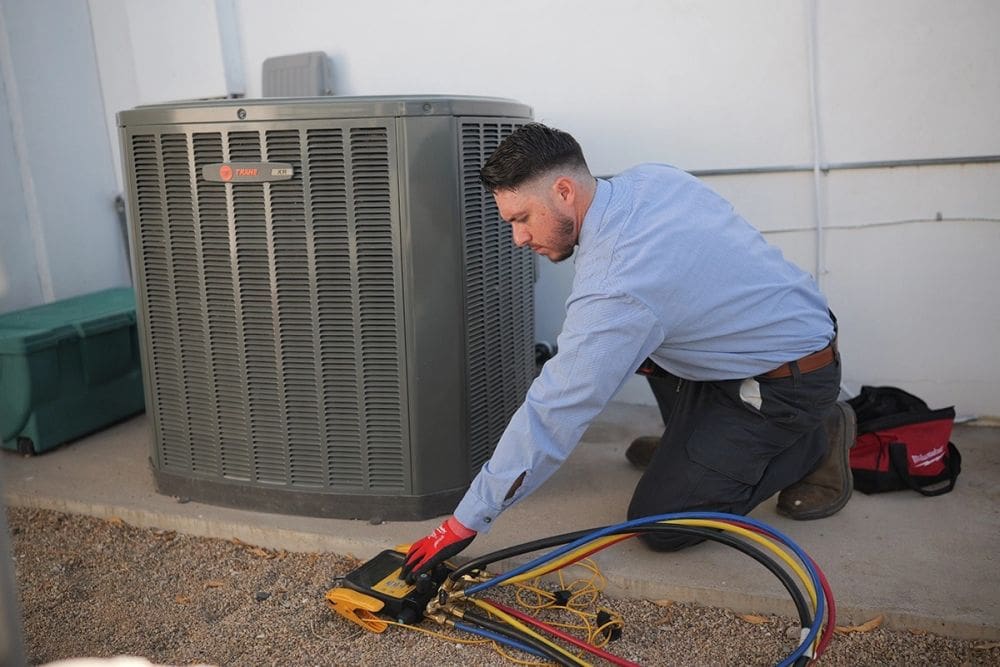
Emergency AC service should be calm, quick, and technical. The technician arrives, asks about symptoms, verifies the thermostat call, and checks the outdoor unit for running status. Electrical testing with a multimeter, clamp meter, and capacitance meter follows. Airflow and filtration are verified. If the unit is frozen, defrost begins while the technician inspects the condenser coil and control wiring. If refrigerant performance is in question, superheat and subcooling readings, along with a scan for oil stains and a sweep with an electronic leak detector, guide the next step. Scottsdale calls often end with a tested component replacement and a final performance check to ensure the system will hold temperature the next afternoon when it is 112 outside.
Why AC services in Scottsdale must think like the next afternoon
Many emergency repairs look fine at midnight but fail again at 3 p.m. If the technician did not account for ac services Scottsdale’s afternoon heat. A capacitor that barely meets its microfarad rating at room temperature will drift out of range on a 140-degree pad. A condenser coil that looks clean on the surface may be packed with dust deeper in the fins. A refrigerant charge that is close at midnight may be inadequate when outdoor temperature rises another 25 degrees and the condensing temperature moves up with it. The right emergency fix is judged against Scottsdale’s peak conditions, not the cool of night. That is how Day and Night approaches AC services in Scottsdale during summer. Repairs are tested for headroom, not just minimum function.
What happens when the unit is undersized or oversized
Undersized systems in Scottsdale run non-stop and often fail at night during heatwaves. Oversized systems short-cycle and ice up during monsoon humidity. Both scenarios drive emergency calls. When an emergency visit uncovers a sizing error, the technician should stabilize the home, make the immediate repair, and schedule a Manual J evaluation. This is where experience across the Phoenix metro matters. Technicians who see the same patterns in Ahwatukee 85048, Encanto, and Desert Ridge can spot the clues in Scottsdale quickly and prevent repeat failures.
The shareable number Scottsdale neighbors ask about
Day and Night’s field logs across Phoenix and Scottsdale show a documented summer condenser ambient temperature of 130 to 140 degrees at west-exposure equipment pads. This is a hard number measured with IR thermometers thousands of times. It explains the disproportionate run capacitor failure rate every June and July in neighborhoods from Arcadia and Biltmore to DC Ranch and Grayhawk. Homeowners are often shocked by how small the failing part is compared to the system. Replacing a $20 to $60 component with the right rating and verifying system amperage prevents a $2,000 to $4,000 compressor replacement later. That is the practical math behind 24/7 emergency AC service in Scottsdale.
Why licensing and training matter at 1 a.m.
Arizona requires separate licenses for HVAC and plumbing. Scottsdale emergency AC work must be performed by a contractor holding the Arizona ROC C-39 Air Conditioning and Refrigeration license. When plumbing is involved, the contractor should also hold the ROC C-37 Plumbing license. Emergency refrigerant service requires EPA Section 608 certification. In 2026 and beyond, R-454B A2L training is mandatory to service new systems safely. These credentials are not paperwork. They are the backbone of safe after-hours work in Scottsdale garages, side yards, and attic spaces while families sleep nearby.
What a same-night replacement conversation should include
Sometimes a repair is not the right call. A failed compressor in a 12-year-old R-410A system during July 2026 can be a trigger to replace rather than invest further. A professional conversation at the kitchen table in 85258 or 85260 should include the following. The home’s actual load and duct condition, verified with Manual J and static pressure measurement. The SEER2 standards and available equipment tiers, from standard 15+ SEER2 to 18+ and 20+ variable-speed options. The R-454B transition and what it means for future serviceability. The available APS and SRP rebates and the federal Section 25C tax credit if a qualifying heat pump is selected. The team should offer a free estimate, financing options through approved lenders, and a clear installation plan that minimizes downtime. Many Scottsdale homes can receive next-day installation even during peak season. The emergency team should stabilize the overnight condition and hand off to the installation crew without gaps.
Coverage beyond Scottsdale that supports true 24/7 response
Emergency AC services in Scottsdale rely on Valley-wide capacity. Day and Night covers Phoenix from 85001 to 85086, Paradise Valley 85253, Tempe 85281 to 85284, Mesa 85201 to 85215, Chandler 85224 to 85286, Gilbert 85233 to 85298, Glendale 85301 to 85310, Peoria 85345 to 85383, and Fountain Hills 85268. That reach matters because heatwaves do not respect city limits. Trucks positioned across the Valley let the dispatch center route the closest qualified technician to Scottsdale at any hour, including during monsoon storms when surface roads clog and the fastest path may be Loop 101 or Loop 202 around closures.
The quiet cost of waiting until morning
Many homeowners hope to ride out a night without cooling. In Scottsdale, this decision carries cost beyond discomfort. As the house heat-soaks, materials expand and humidity rises inside during monsoon season. Refrigerators, freezers, and electronics work harder. Pets suffer. Elderly residents and infants face real risk. By morning, the AC faces a harder start after hours of stagnation. What might have been a quick capacitor swap becomes a locked compressor or blown contactor. The difference between a midnight repair and a next-afternoon failure is not a scare tactic. It is a pattern the technicians see every July and August across Old Town, McCormick Ranch, and North Scottsdale.
The hidden role of duct leakage in emergency calls
In older Scottsdale homes and some 1980s tracts, duct leakage steals a large share of cooled air into the attic. Day and Night often measures 30 to 40 percent supply loss in similar Phoenix homes in Arcadia and Biltmore, and Scottsdale homes show the same. At night, the attic is still hot. Leaked conditioned air increases attic temperature even more, which increases the load the AC must fight. That loop raises amperage and component temperatures, tipping marginal parts over the edge. Emergency AC service that includes a quick duct static and temperature split reading can spot this cause and prevent the next call by recommending air duct sealing or replacement along with the immediate repair.
Small design details that make a big difference in Scottsdale
Technicians who work Scottsdale every day see recurring design issues. Outdoor units installed in recessed alcoves that trap hot air and recirculate condenser discharge. Landscaping that grows into the condenser coil and blocks airflow. Drain lines that lack a proper cleanout and slope, causing frequent float switch trips. Air handlers in garages with insufficient return air paths. Each detail can trigger a night call during heatwaves. Emergency teams that fix the symptom and flag the design issue reduce repeat calls even in the busiest weeks.
AC services in Scottsdale that scale with the desert climate
There is a simple standard for judging 24/7 emergency AC service in Scottsdale. Does the provider test and repair with Scottsdale’s climate in mind, or do they treat the home like any other U.S. City? The difference shows up in the tools carried, the parts stocked, and the conversation had at midnight. Scottsdale homeowners should see a methodical check of the run capacitor, contactor, condenser coil, refrigerant performance, thermostat control, airflow, and condensate drain. They should hear a clear explanation of the R-454B transition if the system is newer, the SEER2 standards if replacement is discussed, and the APS, SRP, and 25C incentives if a heat pump is considered. They should receive written flat-rate pricing and a path to same-day installation if needed. That is how emergency AC services in Scottsdale earn their place as essential, not optional.
Why true local authority matters during emergencies
Day and Night has served the Phoenix metro, including Scottsdale, since 1978. The team knows how Arcadia’s mid-century ductwork leaks, how Ahwatukee’s 85044 and 85048 attic temperatures behave, how Desert Ridge 85050 and 85054 equipment pads bake in afternoon sun, and how Old Town Scottsdale homes mix older infrastructure with modern loads. This history produces better decisions when everyone is tired, hot, and wants the AC back now. Emergency service is not a commodity in Maricopa County’s summer. It is precise, local work built on decades of specific experience.
Ready when the AC fails tonight
If a Scottsdale home or business is warming up right now, fast, qualified help is available. Day and Night Air Conditioning, Heating and Plumbing provides 24/7 emergency AC repair across Scottsdale and Maricopa County with same-day availability for urgent calls, upfront flat-rate pricing presented in writing before any work begins, and technicians trained for the 2026 R-454B standard and the current SEER2 framework. The company is Arizona ROC C-39 HVAC and ROC C-37 plumbing licensed, EPA Section 608 certified, and has served the Valley since 1978 from the headquarters at 3669 E La Salle St in 85040. Free estimates are available on new HVAC system installations, with financing through approved lenders and documentation support for APS Cool Rewards, SRP HVAC rebates, and the federal IRA Section 25C credits. For AC services in Scottsdale that answer the call at any hour, contact Day and https://pub-12921bf854624cf19e75163faf68c687.r2.dev/scottsdale/why-scottsdale-ac-systems-fail-faster-than-almost-anywhere-in-arizona.html Night at (602) 584-7758.
Day & Night Air Conditioning, Heating & Plumbing AZ Licenses: ROC335883 | ROC335884 📍 Phoenix Headquarters 3669 E La Salle St,
Phoenix, AZ 85040 📞 24/7 Service Phone (602) 584-7758 Get Directions Visit Website 📘 Facebook 📸 Instagram 💼 LinkedIn